

The Knot That Conquered the World: A History of the Necktie
1630, Paris
Picture a regiment marching into the French capital — mercenaries from the Croatian frontier, hardened by years of fighting in the Thirty Years' War. They're impressive enough as soldiers. But it's not their swordsmanship that turns heads on the streets of Paris. It's what's tied around their necks.
Loosely knotted scarves, some plain linen, some fine silk depending on rank — worn originally as a practical piece of kit, doubling as a sweat cloth and a way to fasten the collar of a shirt. To the Croatian soldiers, it was simply part of the uniform. To the French, watching a foreign regiment march past in perfect, unfamiliar style, it looked like fashion.
King Louis XIII was reportedly among the fascinated. Word spread through the court. Within a few years, French nobility was tying the same knot around their own necks — and giving it a name that still carries the accessory's origin story inside it: la cravate. A French mangling of Croate. Croat.
That's the necktie's origin. Not a tailor. Not a designer. A regiment of soldiers, four centuries ago, who wore something functional so well that an entire continent decided to copy them.
A Uniform Becomes a Statement
Once the cravat crossed from the battlefield into the ballroom, it stopped being about function and started being about status. By the mid-1600s, the fabric you wore around your neck said something about who you were. Coarse cloth meant you were a foot soldier. Lace and fine silk meant you had money, or proximity to it.
Louis XIV — the Sun King himself — is said to have gone further, creating a dedicated royal regiment, the Cravates Royales, composed largely of Croatian soldiers, cementing the cravat as a fixture of French military and court dress alike. For the next century and a half, the cravat wasn't a single object so much as an entire category of neckwear — draped, knotted, pinned, and folded in dozens of competing styles, each one a small declaration of taste.
Enter the Dandy
Fast forward to Regency London, and the cravat finds its most obsessive champion: Beau Brummell. Brummell wasn't a nobleman by birth, but he became the single most influential arbiter of men's style in Britain almost entirely through the precision of his dress — and the cravat was his signature battleground.
Where earlier cravats had been elaborate and decorative, Brummell's were famously crisp, understated, and exact. Legend has it he could spend hours getting the fold and knot exactly right, and would simply discard a cravat that didn't sit perfectly rather than wear it imperfect. It sounds excessive — until you realize he basically invented the idea that a piece of cloth around your neck could be a marker of quiet, disciplined taste rather than loud decoration. That idea has never really left menswear since.
By 1818, the obsession had grown large enough to produce Neckclothitania, an illustrated guide cataloguing the era's most elaborate cravat styles. It's also the first known printed text to use the word "tie" instead of "cravat" — a small, easy-to-miss line in a fashion pamphlet that quietly marks the birth of the word we still use today.
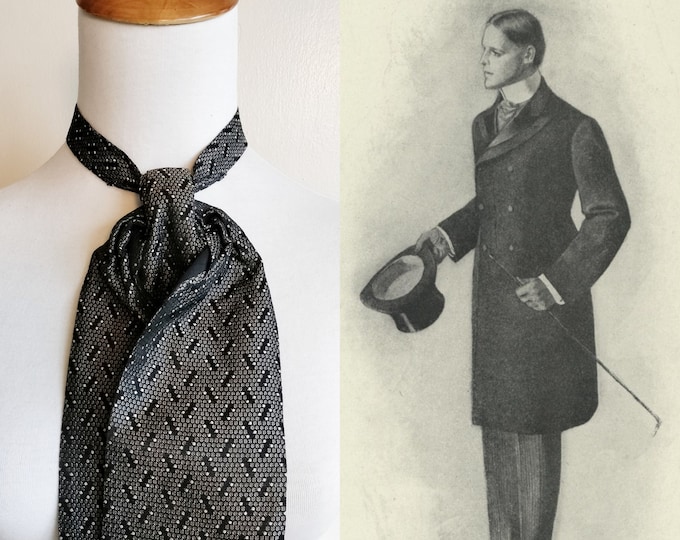
From Cravat to Necktie
Through the 19th century, as stiff, structured collars gave way to softer, turned-down ones, the cravat began to simplify. The knot that would eventually dominate — a simple, diagonal wrap now known as the four-in-hand — started replacing the more elaborate cravat styles. Some accounts trace the name to London's Four-in-Hand driving club, whose members supposedly tied their neckwear the same casual way they held their carriage reins.
Whatever the exact origin, the shift mattered: for the first time, the necktie was becoming genuinely simple to tie, which meant it could become genuinely common — not just an aristocratic flourish, but something any man with a shirt and a collar could wear.
Then, in 1926, a New York tailor named Jesse Langsdorf changed the necktie's construction itself. He began cutting ties on the bias — diagonally across the fabric grain — instead of straight. The result: a tie that hung evenly, didn't twist after being knotted, and kept a woven pattern running diagonally across the front instead of distorting. It sounds like a small tailoring detail. It's actually the reason a modern tie drapes the way it does at all.

The Duke Who Didn't Invent His Own Knot
If there's one myth that refuses to die in the story of the tie, it's this one: the Windsor knot was not invented by the Duke of Windsor.
Edward VIII — later the Duke of Windsor — was one of the most photographed style icons of the early 20th century, known for favoring a large, substantial knot. But by most tailoring accounts, he achieved that look simply by tying an ordinary four-in-hand knot with unusually thick fabric, not by inventing a new technique. American onlookers, seeing the bulkier knot in photographs and copying the look rather than the method, ended up double-wrapping thinner ties to recreate it — and in doing so, accidentally invented an actual new knot, which the public promptly named after the Duke anyway.
It's a fitting bit of irony: one of the most recognizable knots in tie history is named after a man who never tied it.
A Small Piece of Cloth, A Long Memory
What's striking, looking back across four hundred years, is how little the necktie's core purpose has actually changed. It started as something practical worn by soldiers. It became a marker of rank, then of taste, then of professionalism, then — for a long stretch of the 20th century — almost a uniform in itself, tightly bound to ideas of class and respectability.
Today, the tie occupies a strange place. It's optional in most workplaces, worn more by choice than obligation, which arguably makes it more expressive than it's been in a century — nobody's required to wear one, so the ones still worn tend to mean something to the person wearing them.
A tie has always been a small piece of fabric carrying an outsized story — of soldiers who never intended to start a fashion movement, of a dandy who nearly went broke perfecting a fold, and of a duke who got credit for a knot he never actually tied. Next time you knot one on, you're not just dressing. You're the latest link in a chain that started on a 17th-century battlefield.